SEO Daily — 26 April 2026
Posted on: 2026-08-15
By: Geoffrey Lord
5 Underutilised 2026 Ranking Tactics That Actually Move the Needle
Why most SEO advice is still wrong in 2026 Google's December 2025 core update rewrote the rules. The sites that lost 22% of visibility were running on "AI-assisted summaries" — content that summarised what was already on page one.

The winners were sources: original data, real execution proof, and firsthand experience. This matters because the tactics that worked in 2022 and 2023 — keyword density, volume publishing, generic listicles — are now structural liabilities. If your content could have been written by anyone, it would be outranked by someone who lived it. So here are five tactics that are genuinely underutilised right now, backed by 2025–2026 data.
Tactic 1: Build Entity Authority, Not Just Backlinks
The problem: SEOs still chase domain authority as the primary off-page signal. In 2026, Google's AI evaluates entities — people, brands, well-defined concepts — not just domains. Your author needs a digital profile. Your brand needs a consistent identity across every platform. The mechanism: AI answer engines (ChatGPT, Perplexity, Gemini) triangulate information across the web. If your brand name appears consistently with the same attributes — the same phone number, address, service descriptions, and authors — AI confidence in your entity increases. If data conflicts, AI won't cite you.Implementation checklist:
- Create a named author page with a professional background, not just a bio paragraph
- Claim and verify your entity on Google Knowledge Graph (via Knowledge Panel management
- Ensure NAP (Name, Address, Phone) is identical across Google Business
- Profile, Apple Business Connect, Bing Places, Yelp, and your website
- Run a citation audit: find and fix any platform where your phone number or address differs
- Link author social profiles to content via author schema markup
Tactic 2: Optimise for INP, Not Just Page Speed
The problem: Page speed has been a ranking signal for years. But in 2026, Google measures Interaction to Next Paint (INP) — how quickly your page responds to user actions across the entire session, not just initial load. INP replaced First Input Delay (FID) as the Core Web Vital for interactivity in 2024, and sites with INP above 200ms are now seeing a measurable ranking penalty in mobile search. The mechanism: If a user clicks your menu, a button, or a form field and feels any lag — even 100ms — Google registers that as a negative experience signal ("pogo-sticking"). These signals aggregate and feed back into your ranking for that query.Implementation checklist:
- Run your pages through PageSpeed Insights and check the INP score specifically (not just the overall score
- Audit JavaScript that runs on user interaction — heavy third-party scripts are the most common INP killers
- Lazy-load non-critical scripts so they don't block interaction
- Test your mobile templates on real hardware, not just emulation — real device INP is what Google measures
- Fix layout shifts that occur during page interaction (late-loading banners, dynamically sized images)
Tactic 3: Build Topic Clusters, Not Content Silos
 The problem: Most sites create pages around individual keywords. In 2026, Google evaluates topical authority — whether you are the clear expert on a subject, not just a page that ranks for one term.
A site with 20 deeply interlinked articles on a single core topic outranks a site with 200 loosely related pages.
The mechanism: Google's AI interprets your content ecosystem, not individual pages.
If you cover a topic from multiple angles — pillar page, supporting articles, comparison guides, case studies — all linking together semantically,
Google sees you as the source. This is also how AI answer engines decide who to cite.
Implementation checklist:
- Choose 3-5 core topic areas where you have genuine expertise (not just search volume)
- Create one comprehensive pillar page per topic (2,000+ words, complete coverage)
- Build 4-8 supporting articles per pillar, each covering a sub-angle in depth
- Link supporting articles to the pillar and to each other using descriptive anchor text
- Update pillar pages when you publish new supporting content — the pillar should grow with the cluster.
Tactic 4: Write for Answer Engines, Not Just Search Engines
The problem: Standard SEO still optimises for Google's traditional 10 blue-link results. But AI Overviews now appear in 16% of queries (down from 25% a year ago — Google is pulling back from overreach, not because it failed). More critically, half of all searches now end without a click. If you are not in the AI answer, you are invisible. The mechanism: AEO (Answer Engine Optimisation) means structuring your page to be the complete, self-contained answer that AI systems can extract and present. This requires: (a) answering the primary question immediately, without preamble; (b) anticipating and answering follow-up questions within the same page; (c) using structured data (FAQ, HowTo, Product schema) that AI can parse unambiguously.Implementation checklist:
- Write your H1 as the direct answer to the search query, not a topic heading
- Open each article with the answer in the first 50 words — don't bury the conclusion
- Add an FAQ section with questions drawn from "People Also Ask" and related queries
- Use FAQ, HowTo, and Article schema markup on every content page
- Include a "What to expect" or "Next steps" section at the bottom for follow-up query coverage
- Avoid walls of text — break content into scannable sections AI can extract as discrete units.
Tactic 5: Track AI Visibility, Not Just Keyword Rankings
 The problem: Your Google rank means nothing if AI answer engines are recommending your competitors instead. Yet most SEO reporting tracks nothing beyond Google Search Console — leaving AI discovery entirely unmeasured. The mechanism: Platforms like Local Dominator's AI Tracker, Sparktoro, and Semrush's AI visibility tools now measure how often your brand is cited by ChatGPT, Perplexity, Gemini, and other AI systems. This "AI Visibility Score" is the new authority metric — and it's decoupled from Google rankings in meaningful ways. A brand can rank #1 on Google and be invisible in AI answers if its data is inconsistent or its entity isn't verified.
Implementation checklist:
- Run a baseline AI visibility audit using Local Dominator's free tier or Sparktoro
- Identify which AI platforms are referencing your category competitors but not you
- Fix the three most common AI citation blockers: inconsistent NAP, missing author entities, thin entity profiles
- Set a monthly AI visibility metric alongside your existing keyword rank tracking
- Test your own queries on Perplexity and ChatGPT to see what surfaces for your key terms — manual spot-checks are faster than tools for small teams
Quick Wins This Week
If you're short on time, do these in order:
- Audit your INP on mobile (PageSpeed Insights → more → INP). If it's above 150ms, that's your priority.
- Fix one inconsistent NAP citation — pick the most visible directory where your data differs and correct it.
- Add FAQ schema to your top 5 pages — the pages already ranking on page 2. Structured data on those pages can trigger rich results and AI citations without additional content work.
- Check one competitor's AI visibility — search your category term on Perplexity. Who is being cited? That's your benchmark.
SEO Daily will run each cycle as a standing section. Next issue: "The E-E-A-T trap — why most 'expertise' content fails Google's experience filter."
SEO Articles by Geoff Lord
The Marketing Tutor
2026-09-08
Car Body Repairs in Bacup
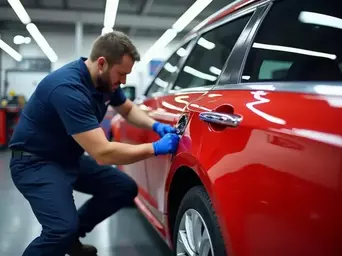 When it comes to maintaining your vehicle, knowing your options is key. With a variety of services a
2026-09-07
Understanding Autoline Car Body Repair Services
Autoline Car Body Repair Services In Bacup
Did you know that choosing the right car body repair ser
2026-09-05
Affordable Car Body Repairs In Bacup
 Here are five topics related to Autoline Car Body Repair Specialist in Bacup, UK, ranked in order of